 |
| Decorations for la Navidad are starting to appear everywhere. The box at the base of this tree in the San Blas town square was stuffed with handwritten "carta para Santa" |
December 9th -- I just noticed the date – it’s a
3-month marker for our trip. We left Seattle on September 9th. I
find myself trying to keep an overall balance between being reflective and just
being.
In hindsight I’d say the first month was characterized by
exhilaration (pushing off, the wild ride, the ever changing conditions).
The second month I felt euphoric (hitting Mexico, the
tropical climate, beaches, and rapid progress in language study).
The third month has been one of acclimation (to the
day-to-day life of this kind of travel
-- decisions to move on or stay put, relative rolliness or
calm of an anchorage, nurturing an appreciation of both nature and culture, and
putting it in perspective when we’re a little tired of this or that).
Looking ahead, on some days a “year of travel” feels like a
very long time. Certainly a long time to see one country, but maybe not too
long to try to really experience another culture. We have both mentioned to one
another at various times that we are glad we don’t have to hurry and that the
pace of our travel is giving us a sense of Mexico and the spirit of the people
that would be hard to know in a shorter time.
Things we notice are that Mexicans on the whole are open,
with ready smiles and easy eye contact. The habitual greetings on the streets –
Buenas dias, buenos tarde, o bueno noche – are universal, offered and
reciprocated between all ages and demographics – which seems to break cultural
barriers and make us, at least, feel welcome among strangers. When we can offer
just a little bit more in Spanish, such as asking “Como esta ustedes?” or “A
donde viva? Cuantos anos tienen los ninos? we are treated as a welcome friend.
While our bad accents and grammatical errors are rampant, we are answered as if
we were fluent. Our blank stares in return prompt slowing down and the patient
use of preschool vocabulary.
Another cultural trait we notice and often comment on is the
warmth and (apparent) health of the Mexican family. Across economic classes and
geographics we see parents (often young looking couples) spending time with
their kids… and enjoying it! Children are appreciated and included in whatever
the parents (and often extended family) is doing, from eating in restaurants,
walking the malecon, or playing in the surf. Somehow there is a good balance
between parents attending to, smiling at, and interacting with their children,
without being over-attentive or providing constant entertainment for them. Kids
for their part, are along for the ride, and seem really good at making their
own play, sans electronics. Whether from lack of accessibility or cultural
tradition, kids here are not as “plugged in,” as we are used to seeing in the
states. It’s nice.
Enough rambling… here’s where we’ve been and some highlights
of the past week, as we came north from Bandaras Bay to explore the town of San
Blas and several anchorages on the way.
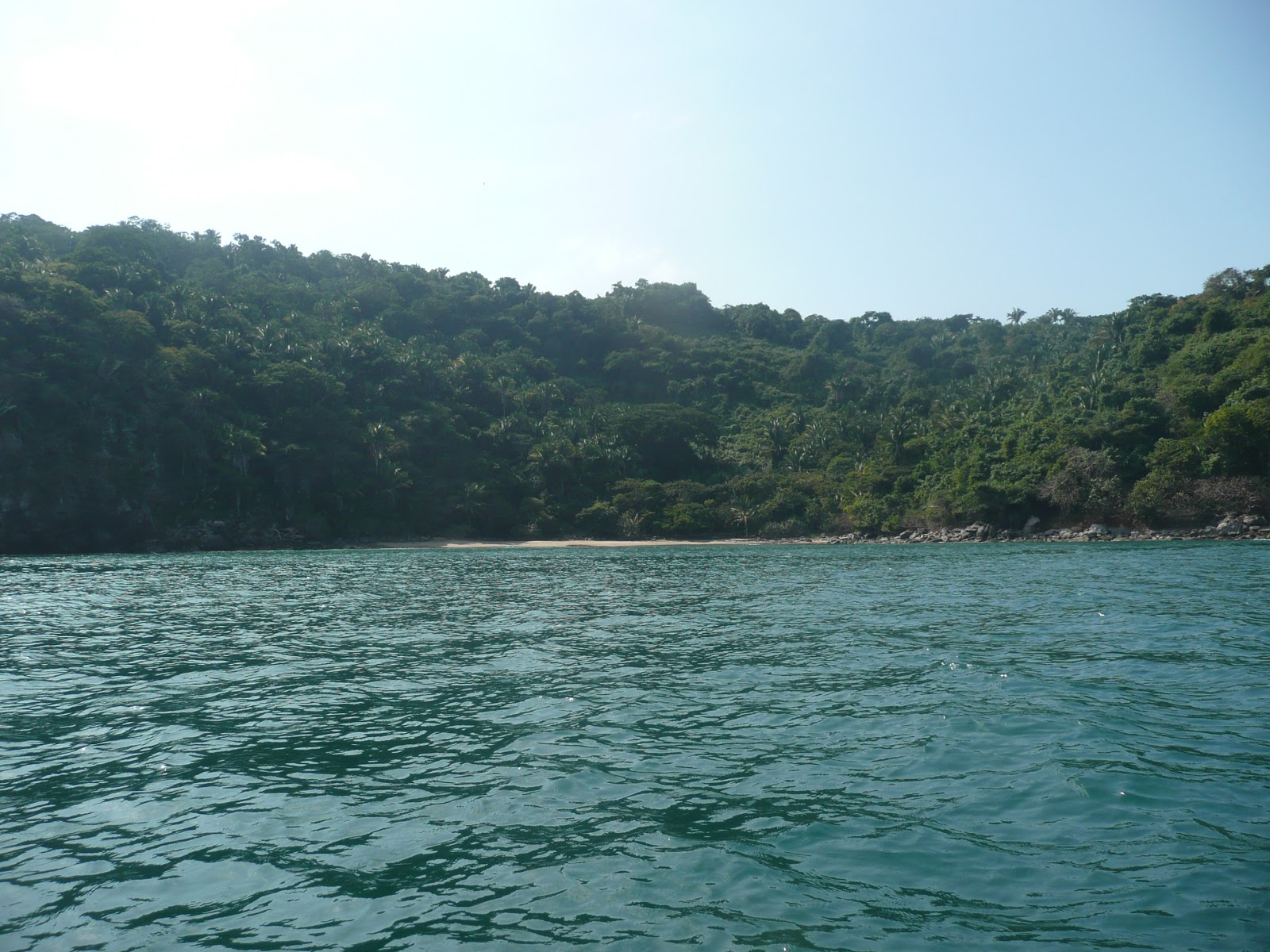 |
| This looked like the "perfect" private beach for a lunch stop. |
A terrific bit of close reach sailing brought us around
Punta Mita and about 35 miles north to Bahia Jaltemba. This is a series of
sandy beaches, with tourist rich hotels, palapa restaurants, surfing and
snorkeling concessions that are north of PV and of Sayulita. As we were headed
in to check out the anchoring area that was prescribed in our guidebooks we
looked to the right and both said, “That looks like the perfect beach…” a small, sandy, deserted cove, with
palms and lush tropical overhanging cliffs. It was noon, so we hung a right and
found the depth and holding to be fine. Thirty minutes later we found
perfection on “our beach,” and spent a couple hours swimming, relaxing, and
taking it in. The water was back to being crystal clear, turquoise blue, and so
inviting!


We anchored off Isla Pena, staying aboard rather than
venturing to the hotel strip that night. The spot was rolly (what else is new?)
and we seem to take turns being able to sleep through the swells. In the
morning, I was awakened at pre-dawn by Lanham saying it was time to leave – we
didn’t want to press our luck. During the night we had silently dragged anchor,
closer to the island and the rocks off the island. The anchor had safely reset
itself in 27 feet of water and we were holding fine. We have gotten more lax about
using the computer anchor-watch alarm, partly because of false alarms (no fun)
and partly because the holding is usually so reliable. We calmly, but quickly,
pulled in the flopper stoppers and weighed anchor, getting a nice early start
to head up to San Blas.
 |
| Some of the pangueros who guided us around their nets. |
Early afternoon we arrived at the big flat water of
Mantanchen Bay, where we had decided to anchor for our trip into San Blas. San
Blas itself is another 4 miles around a point and up a long estuary. In
addition to being known for its history as the main settlement and military
hold of the Spanish colonialists, the anchorage at San Blas is known for its
mosquitos and jejenes (biting no-see-ums). We dropped anchor about a mile out
to keep the buggers at bay. We could have anchored up to 10 miles offshore, as
this bay is Big and Shallow (about 20 square miles, all of it 20 – 30 feet
deep). The shores are backed by lots of greenery – old coconut and banana
plantations we read – and beautiful hills and mountains, the tallest about
8,000 feet. We inaugurated our full collection of bug screens – covers for all
the hatches – just another fringe bene that came with Solar Wind, which we now
fully appreciate.
The beachfront at Mantanchen Bay is populated with miles and
miles of thatch-roofed palapas… almost all rather eerily deserted. In the
evening, we saw a light and smoke coming from one and made our way in by dinghy
for a cold beer and some ceviche. A couple other tables were occupied with
locals, and the very effective method for deterring the jejenes was the smoking
bucket of coconut husks that they position at the foot of your table. We met
the madre de familia Rodriguez, who cheerfully cooked us eggs for breakfast the
next morning, though she seemed not to expect customers. She was there on
Friday morning it seemed, to get ready for the weekend when she said many
people would come to the beach. She assured us it was fine to leave the dinghy
on the beach all day, which we did with no problems. Dinghy wheels are the way
to go, allowing us to pull it way up out of the tidal range.
 Friday, we walked up the dirt road from the beach, choosing
from the two dozen roadside stands for a refreshing “coco frio” and some of the
local specialty, pan de platano (banana bread). We both enjoyed our first
coconut milk, straight from the hull, then watched as our vendor split the nut,
and spooned out the soft fresh meat. We carried it back to the boat and toasted
it on the stovetop – yum!
Friday, we walked up the dirt road from the beach, choosing
from the two dozen roadside stands for a refreshing “coco frio” and some of the
local specialty, pan de platano (banana bread). We both enjoyed our first
coconut milk, straight from the hull, then watched as our vendor split the nut,
and spooned out the soft fresh meat. We carried it back to the boat and toasted
it on the stovetop – yum! 


We caught a bus. We love the Mexican public transport (at
least along the coastal highway 200). They run LOTS of high speed, early model
buses, with layers of aluminum nailed to the floor and roadway peeking through.
The windows and doors remain open and polyester curtains blow in your face as
you race around the turns. The bus stops are… wherever the passengers want to
hop on or off. Pay your 12 pesos ($1), change is made efficiently by the
driver, and off you go. Ahh, if only Seattle Metro could get it figured out!
 |
| You do have to watch out for the 8 inch scorpions at the bus stops! |
So we caught a bus for the 6-mile ride into San Blas,
getting off at the central plaza. Had a totally pleasant self-guided tour
around town, finding the old cathedral that housed Henry Wadsworth Longfellow’s
“the Bells of San Blas,” published posthumously. We saw the new cathedral, the
cultural center, and walked through a very lovely “petit hotel,” in a historic
building. The Huichol Indians sell many of their arts around the plaza. Small
beaded articles are a specialty. We had a beer and visited the book exchange at
“BillyBob’s Cantina” known for its (very depressed) 60 year old crocodile in
the courtyard (so sad!)
 |
| The courtyard of la Hacienda Flamingo -- an old and refurbished hotel in San Blas Cento |
 |
| The Flamingos front door knocker |
 |
| Two hotel guests! |

 |
| Henry Wadsworth Longfellow's Bells of San Blas |
 One of the characteristics that dominate in San Blas is the
variety of modes of transport used in the narrow cobbled streets. I wish I’d
had the chance to do a photo-essay of people getting around the town. Bicycles
were the most common, for young and very! old. Helmets were fairly popular, but
clearly not required, and seldom strapped under the chin. Many bikes had wooden
seats constructed for kids to ride behind the handlebars, and tiny ones who
looked like they had just learned to sit up looked very comfortable helping to
steer. Some parents were toting
one kid on the front and one on the back. There were three-wheelers, both
motorized and peddled, motorbikes with cargo loads, and our favorite, the
pick-up trucks with rockers or straight-back wooden chairs lined up in the back
for the abuelas y abuelos, riding proudly through town. We also loved the
mysterious-looking white delivery truck with its large hand-painted black
lettering “PRECACION! EQUIPMENTO TECNICO!” You know they had some special
stuff.
One of the characteristics that dominate in San Blas is the
variety of modes of transport used in the narrow cobbled streets. I wish I’d
had the chance to do a photo-essay of people getting around the town. Bicycles
were the most common, for young and very! old. Helmets were fairly popular, but
clearly not required, and seldom strapped under the chin. Many bikes had wooden
seats constructed for kids to ride behind the handlebars, and tiny ones who
looked like they had just learned to sit up looked very comfortable helping to
steer. Some parents were toting
one kid on the front and one on the back. There were three-wheelers, both
motorized and peddled, motorbikes with cargo loads, and our favorite, the
pick-up trucks with rockers or straight-back wooden chairs lined up in the back
for the abuelas y abuelos, riding proudly through town. We also loved the
mysterious-looking white delivery truck with its large hand-painted black
lettering “PRECACION! EQUIPMENTO TECNICO!” You know they had some special
stuff.
For our second day of sightseeing in the area, we made an
appointment for a panga ride up the Rio Tovara, a “jungle tour,” that we had
read much about. We showed up at 8 am for our early morning start, only to find
out from the nice hombre cleaning up that it was 7am. We have been crossing
back and forth between the two time zones along this part of the coast, not
bothering to worry about the hour difference. This day, it meant we had our
coffee at 4:30 am before leaving the boat at daylight. Our driver showed up
early and by 7:30, Juan was taking us up river on a most relaxing and beautiful
ride. He drove a quiet Honda 4-stroke, had a keen eye for the wildlife and
birds that we might have missed, and artfully stopped the boat and idled so we
could get pictures. He taught us the Spanish names of many of the birds. Most
common were the Anhingas (we thought he was saying “Kingas” until we looked it
up later) They were awkward flyers, but looked like great swimmers, and would
open their wings to dry them, displaying their beautiful patterned feathers.
Others we saw included hawks, herons, white egrets, magpies, and several
smiling crocodiles. The fauna changed dramatically as we went from the
salt-intense mangroves at the beginning toward to eventual fresh water spring
at the end of the ride. At the turn around spot there is a small restaurant
(not open in early morning) and swimming area (they just warn you to swim
within the pen to keep the crocodiles from bothering you). We traveled the 45
minutes back and thoroughly enjoyed our jungle trip! Here are a few of our best
photos.


 |
| From our anchor |
Our next anchorage was a smallish bay off the town of
Chacala. We joined 3 or 4 other cruising boats for a couple of nights. It’s a
beach town, with a growing tourist economy, but not yet overgrown.
Here are some around the town scenes from Chacala:
 |
| A wall much older than the trees |
 |
| Up the main street from the beach |
 |
| A beautifully maintained elementary school yard |
 |
| Tree in front of the church |
 |
| One of the many rooms for rent |
 |
| Tidy residences |
 |
| with signs of the season |
Lots of up-scale accommodations seen on a walk through the town, and internet at the beachside restaurants, but also fisherman delivering their morning catch at the pier with no interest in marketing to gringos, and local teenagers showing up after school to ride their boogie boards in the surf. Sunday afternoon brought more Mexican families than touristas to the beach. A group of young people gathered in a circle with some musicians for a type of spontaneous copoera, clapping and chanting. They looked happy and like they were having fun – we didn’t join in, but thought that Anna and Ellie would have been right there with them! We did do some great body surfing, riding big waves and coming up with sand in our hair, ears and swim suits. Chacala was a good stop and we had a nice beach afternoon. Some beach scenes... wish you were here too...


A final highlight of our week’s venture north was sailing
along with two gray whales. They were about the size of the boat. We had been
motoring with the jib out (making water and topping up the batteries) when we
spotted one. We turned off the motor and they seemed comfortable going along at
our speed (about 3 kts) while showing us their blows, fins and tales. Magical.
Majestic. Mesmerizing.
 |
| but hard to capture on camera |

Our freezer is finally emptying. We hadn’t caught a fish
since the Baja Peninsula. We trolled two lines on our way south from Chacala
and caught two small fish! We don’t know the variety, but do recognize them as
the same kind that the pangeros were bringing in (from nets) to Chacala. We
BBQ’d the 4 small fillets -- quite a few bones, but a texture of tuna. Nice to
be eating from the sea again.
Another overnight stop at Punta Mita (there is something
very relaxing about a familiar port) and then we headed back to the marina at
La Cruz. We have gotten a slip and our exhaust pipe has arrived! Tomorrow we
will install it, get caught up on laundry, groceries, and a couple nights’
sleep without the giant waterbed underneath us.
Next up?
We are revamping our plans as we continue to read up on the
southern destinations. We think we may only go as far as Tenacatita Bay, maybe
to the small town of La Manzanilla at Christmas. We think we prefer the drier,
more rugged, less populated anchorages that we expect we will find in the Sea
of Cortez. The truth about going far south is that with our itinerary, we will
have to come north again – mostly into the wind, adding distance. We will see,
it’s day to day living, but we both like to have a few scenarios in our minds.
To that end, we have added the structure of a couple of firm dates. Melinda is
going to come to Seattle for a week at the end of January (anyone want to fly
to La Paz and hang out with Lanham and the boat). My folks are moving from
their home of 50+ years so I want to help a bit. And we will meet Anna and
Ellie in La Paz the first week of March, for a family Spring Break.
Thanks for your messages and for surviving the winter
weather whatever it may be where you are! Happy Holidays!! We'll be in touch. Love, M & L


